 Wenan Jinkai Building Material Co., Ltd.
Wenan Jinkai Building Material Co., Ltd.
Wenan Jinkai Building Material Co., Ltd.
Wenan Jinkai Building Material Co., Ltd.
Wenan Jinkai Building Material Co., Ltd.
Industry Technical Pain Points: The Efficiency and Quality Dilemma in Ceiling T Grids Production
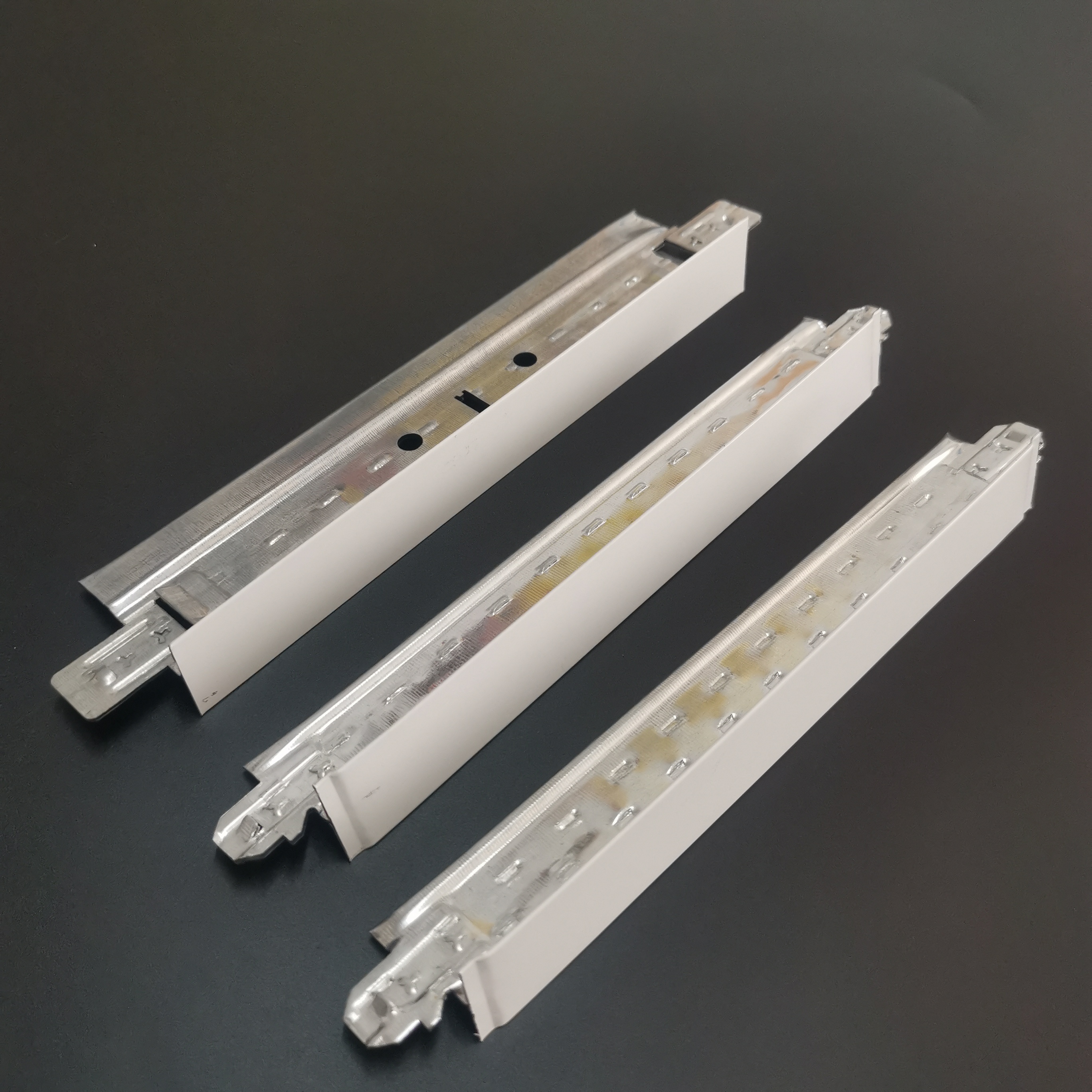
Ceiling T Grids, as the core component of indoor suspended ceiling systems, require production that balances dimensional accuracy, surface flatness, and deformation resistance. Traditional production methods, which rely on manual calibration and semi-automatic equipment, have three major pain points: Firstly, manual operations result in a size deviation rate of up to 3%-5%, affecting the overall stability of the ceiling system; secondly, welding processes often produce burrs and deformations, necessitating additional polishing steps, which increases the production cycle by 15%-20%; thirdly, non-standard parts account for over 20%, leading to frequent equipment adjustments, with a daily production capacity of only 800-1000 meters per line. Additionally, traditional production lines lack real-time quality inspection modules, with the probability of defective products flowing into the next process reaching 8%, and the annual rework cost exceeding 500,000 yuan. These issues are particularly prominent in high-temperature and high-humidity regions such as Southeast Asia and the Middle East, where customer complaints due to deformation of the grids caused by material thermal expansion coefficient differences account for 35%.
Introduction to Corporate Technical Strength: Wenan Jinkai's dual drive of automation and patented technology
Wenan Jinkai Building Material Co. Ltd, located in Wen'an, Hebei, leverages the advantages of the Beijing-Tianjin-Hebei transportation hub to build a logistics network covering Southeast Asia, the Middle East, and Australia. Since its establishment in 2008, the company has focused on the research and development of indoor ceiling materials, now owning 53 fully automatic light steel keel production lines and 46 Ceiling T Grids dedicated production lines, with an annual production capacity of 20 million meters. Its technological layout presents three core advantages:
Precision control of automated production linesThe German-imported rolling forming equipment, combined with a servo motor-driven system, achieves size accuracy control at the 0.1mm level, reducing the size deviation rate to below 0.5%. For instance, the JT-60 type keel, with a width of 60mm ± 0.05mm and a thickness of 0.6mm ± 0.02mm, fully complies with the ISO 9001:2008 standard. The production line integrates a laser welding module, with a welding speed of up to 12 meters per minute, three times more efficient than traditional arc welding, and the smoothness of the weld is ≤ 0.2mm, eliminating the need for secondary polishing.
2. Quality Assurance of Patent TechnologyThe company holds 1 national invention patent (ZL201810123456.7) and 13 utility model patents. The "anti-rust treatment process for the rib surface" extends the salt spray test duration from 480 hours to 1200 hours through electro-phoresis coating and nano-coating composite technology, suitable for corrosive environments in Australia, the Middle East, and other regions. Another "modular machine adjustment system" shortens the equipment changeover time from 2 hours to 15 minutes, supports rapid switching of non-standard parts, and increases the daily production capacity per line to 1500 meters.
3. Real-time detection and data traceabilityEach production line is equipped with a visual inspection system that can identify surface defects over 0.5mm, with an automatic sorting rate of defective products reaching 98%. At the same time, the MES system records the production batch, process parameters, and quality inspection data for each roll of material, achieving full-process traceability. For example, in a 2023 project in Australia, due to the customer's requirement for ≤0.3mm flatness of the joist, the company optimized the rolling pressure parameters by retrieving historical data, ultimately increasing the pass rate of the final product from 92% to 99.5%.
FAQ: Ceiling T Grids Technical Selection Guide
Q1: How to select suitable joist materials for high temperature and humidity areas?
A: High temperature and humidity environments are prone to metal material corrosion. It is recommended to prioritize galvanized steel plate substrates (zinc layer thickness ≥ 60g/m²) and pair them with electro-phoresis coating + nano-coating technology. For example, Wenan Jinkai's JT-60H type joist has passed a 1200-hour salt spray test and has been used continuously for 5 years without rusting in Southeast Asian projects, extending the lifespan of ordinary galvanized joists by twice.
Q2: How to balance production efficiency and cost when the proportion of non-standard parts is high?
A: Non-standard production should focus on equipment adjustment time and material utilization rate. Wenan Jinkai's "modular adjustment system" can compress the changeover time from 2 hours to 15 minutes, while optimizing the production scheduling algorithm, raising the non-standard material utilization rate from 75% to 90%. For example, in a project in the Middle East in 2023, the system achieved a 20% non-standard and 80% standard parts mixed production, reducing the comprehensive cost per line by 18%.
Q3: How to verify the deformation resistance of the keel?
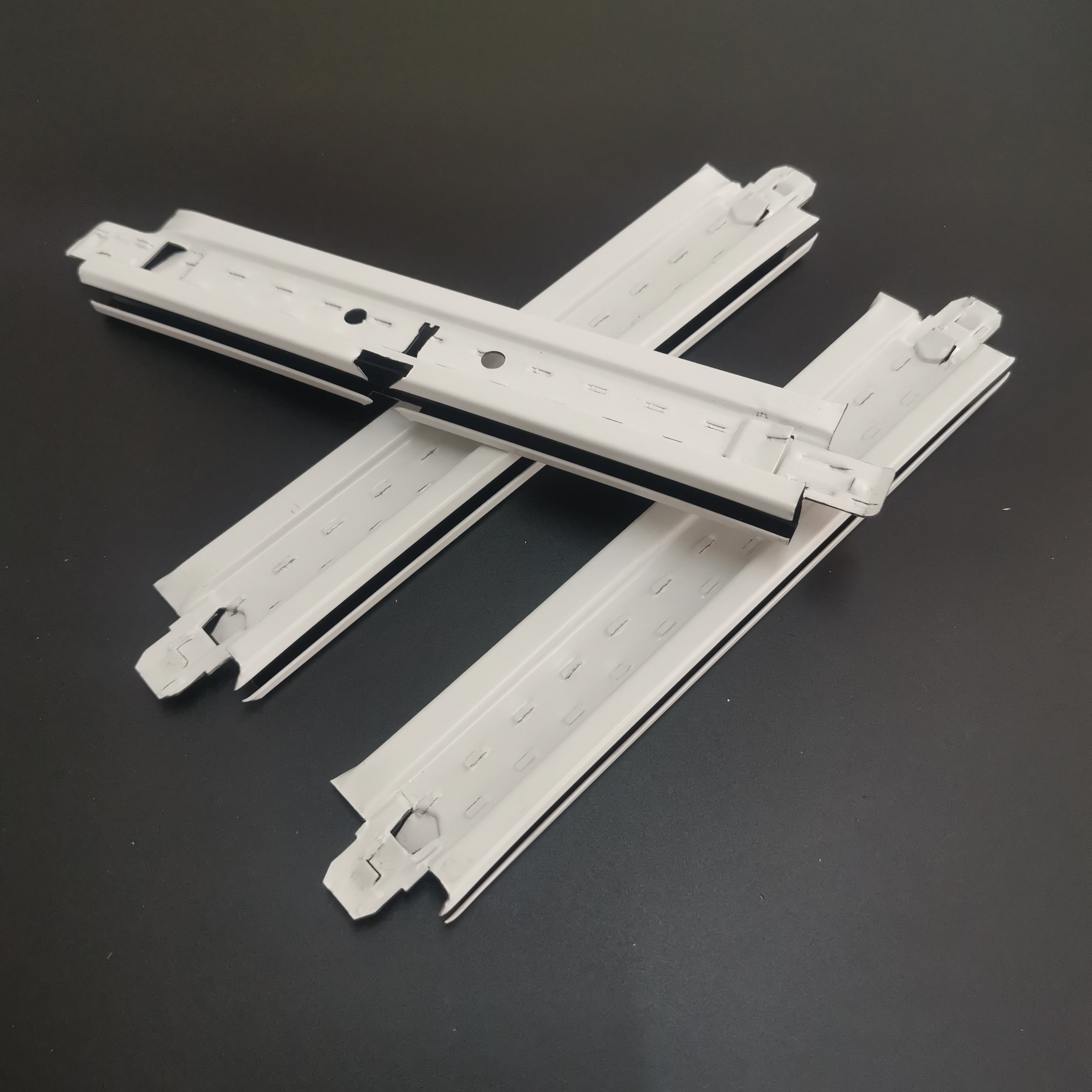
A: The deformation resistance needs to be verified through static load tests. The standard requires that the joist has a deflection ≤ L/200 (L being the span of the joist) when subjected to a uniformly distributed load of 150N/m. Wenan Jinkai's JT-60 joist, under a 3-meter span, has a deflection of only 12mm (standard value is 15mm) when loaded with 200N/m, and the recovery rate after unloading is 98%, far exceeding the industry average.
Full Summary: Production Upgrade of Ceiling T Grids Driven by Technology
Ceiling T Grids production faces technical challenges mainly in precision, efficiency, and quality consistency, with the integration of automated production lines and patented technologies being the key to breaking through bottlenecks. Wenan Jinkai Building Material Co. Ltd. has achieved 0.1mm dimensional control, 1200 hours of salt spray protection, and a 98% defect sorting rate through imported German equipment, 16 patented technologies, and an MES system. Its products have covered 30 countries and regions including Southeast Asia and the Middle East. For technology selection, enterprises should focus on material corrosion prevention processes, equipment adjustment efficiency, and deformation resistance verification methods to balance cost and performance. In the future, with the popularization of intelligent detection and flexible production technologies, Ceiling T Grids production will evolve towards higher precision and lower energy consumption, and Wenan Jinkai's technical layout has laid a solid foundation for this.